How to use the London Underground: a guide for new postgrads
 Posted by
Dino Tassigiannis
9 min read
Let’s be honest: the tube map looks like a bowl of coloured spaghetti. Scary? A little. Complicated? Not really. The London Underground, or the tube as most people call it, is the quickest way to get to lectures, labs and the library in most of London. You don’t need to learn the whole Transport for London (TfL) network. You just need three things: how to pay, how the zones work and which lines run near you. I’ll cover all three, with routes from both Griffon Studios and Wood Lane Studios.
HOW TO USE THE TUBE IN LONDON
First things first: forget paper tickets. Tap a contactless bank card, a phone or an Oyster card on the yellow reader at the ticket gate as you go in, then tap the same card again as you leave. That’s called touching in and out, and it’s how the system works out your fare. Easy, right?
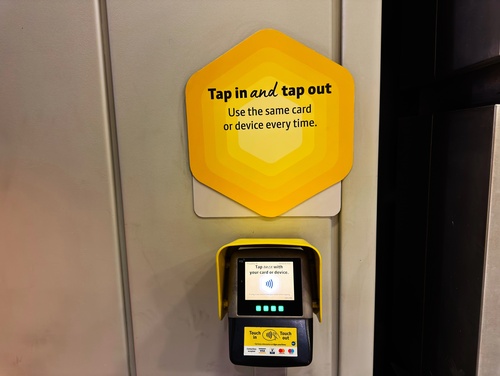
Here’s where people trip up. Use the same card or device every time. Touch in with your phone and out with your bank card? The system sees two incomplete journeys and can charge you a maximum fare. Forgetting to touch out does the same. Painful, and completely avoidable.
Now the good news for your wallet: there’s a ceiling. You’ll never pay more than a set amount in a day or a week. Once your fares reach the daily cap for the zones you’ve travelled in, every other journey that day is free. The weekly cap runs from Monday to Sunday. Seriously, it’s one of the best things about travelling in London.
Off-peak is cheaper. On weekdays, peak time is 06:30 to 09:30 and 16:00 to 19:00. Everything else, weekends included, counts as off-peak. Can your timetable start after half past nine? Then you’ll save on every single journey.
PRO TIP: Pick one card or phone and stick with it for every journey. It’s the easiest way to avoid a surprise maximum fare.
THE TUBE MAP AND LONDON’S ZONES
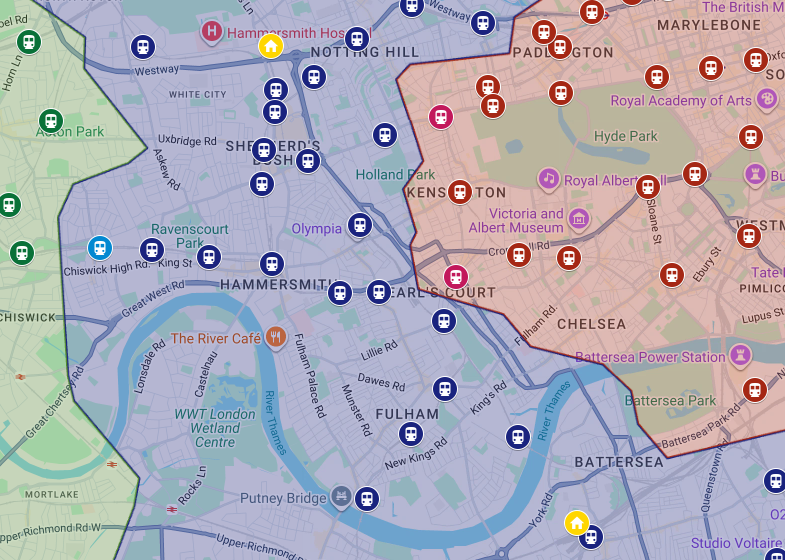
Zones sound technical, right? They’re really just rings. London is split into fare zones, numbered from 1 in the centre outwards to 9. On the tube map, they show up as shaded bands. Your fare depends on which zones you travel through, so a trip inside zones 1 and 2 costs less than one out to zone 6. To make life easier, I’ve created this Google Map with each station and what zone it’s in, so you can stop squinting at the tube map.
Most of your day-to-day travel will probably stay in zones 1 and 2, and both GradPad buildings are in zone 2:
- Wood Lane Studios, White City: White City station (Central line) and Wood Lane station (Circle and Hammersmith & City lines). Zone 2.
- Griffon Studios, Battersea: Clapham Junction (National Rail and London Overground). Zone 2.
A warning before you trust your eyes: the tube map is a diagram, not a street map, so it doesn’t show real distances. Two stations that look miles apart can be a short walk from each other. Check walking times on the free TfL Go app or a maps app before you change trains, and you could save yourself a pointless transfer.
GETTING AROUND FROM WOOD LANE STUDIOS
Wood Lane Studios sits near two tube stations, and between them they cover three lines. Lucky you. If you study at Imperial College London’s White City campus, it’s right next door, so you can walk to campus and skip the commute altogether.
- White City station is on the Central line, which runs east through the middle of London. Think Oxford Circus and Tottenham Court Road for shopping and the West End, Holborn for central London universities, and Bank and Liverpool Street for the City.
- Wood Lane station is on the Circle and Hammersmith & City lines. They run along the north side of central London to Paddington, Baker Street, Euston Square and King’s Cross St Pancras, which makes it handy for mainline trains out of the city.
Heading to Imperial’s South Kensington campus? Imperial suggests taking the Central line from White City to Notting Hill Gate, then changing to the Circle or District line.
And for the night owls: the Central line runs all night on Fridays and Saturdays as part of the Night Tube. That means you can get home from a late night in central London without gambling on a night bus.
PRO TIP: Catching a mainline train from Paddington or King’s Cross St Pancras? Use Wood Lane station, because the Circle and Hammersmith & City lines run straight there.
GETTING AROUND FROM GRIFFON STUDIOS
Here’s a twist: Griffon Studios is a minute’s walk from Clapham Junction, and Clapham Junction isn’t a tube station. Don’t panic. It’s a mainline railway station in zone 2, and trains are part of the same pay as you go system. You touch in and out with the same card, and your journeys count towards the same daily and weekly caps.
Clapham Junction is one of the busiest stations in Europe by number of trains, with at least 100 passing through every hour. Translation: short waits. From here you can take:
- Trains to London Victoria (Southern): central London, with Victoria, Circle and District line connections.
- Trains to London Waterloo (South Western Railway): the South Bank, with Northern, Bakerloo, Jubilee and Waterloo & City line connections.
- London Overground, Mildmay line: towards Stratford, via west and north London.
- London Overground, Windrush line: towards Highbury & Islington, via south-east London.
Trains to Victoria take six to eight minutes and trains to Waterloo take eight to eleven. That puts most of central London within a short commute.
Prefer the tube? Your nearest station is Clapham Common on the Northern line, about an 18 minute walk away. Buses also run from outside Clapham Junction.
PRO TIP: Check the live departure boards before you leave. Trains from Clapham Junction are frequent, so you rarely wait long.
TUBE FARES AND HOW STUDENTS SAVE
Let’s talk money, because that’s what you really want to know. Here’s what you’ll pay in zones 1 and 2, where most students travel. Fares change, so check TfL before you travel.
- Single journey within zone 1, peak: £3.10
- Single journey within zone 1, off-peak: £3.00
- Daily cap, zones 1 and 2: £8.90
- Weekly cap, zones 1 and 2 (Monday to Sunday): £44.70
- Bus or tram, single fare: £1.75, expected to rise to £1.85 after 1 November 2026
Daily and weekly tube caps are frozen until March 2027, which is one less thing to worry about.
Now for the part most students miss. If you’re a full-time student, get an 18+ Student Oyster photocard. It gives you 30% off adult Travelcards and Bus & Tram Passes, so it’s a no-brainer if you travel most days and buy weekly or monthly tickets. By our maths, it brings a monthly zones 1 and 2 Travelcard down from about £172 to about £120. The catch? It doesn’t discount pay as you go fares.
Mostly an off-peak traveller? Then a 16 to 25 or 26 to 30 Railcard might beat it. Add it to your Oyster card and you’ll get a third off off-peak pay as you go fares and daily caps.
PRO TIP: Do the sums before you buy. Travelling most days on weekly or monthly tickets? The Student Oyster photocard wins. Mostly off-peak? Compare it with a Railcard first.
TUBE TIPS FOR YOUR FIRST FEW WEEKS
A few habits will have you looking like a local by week two:
- Stand on the right on escalators and walk on the left.
- Let passengers off the train before you get on, and move down inside the carriage.
- Have your card ready before you reach the ticket gate, so you don’t hold up the queue.
- Download the TfL Go app for live times, delays and step-free routes.
- Travel after half past nine when you can. It’s cheaper, and trains are usually quieter.
The Night Tube runs all night on Fridays and Saturdays on the Central, Jubilee, Northern, Piccadilly and Victoria lines. On other nights, check when your last train leaves, or plan a night bus home. Nobody wants to get stranded at midnight.
Need step-free access? Check before you travel. Not every station has lifts, and the TfL Go app can plan a step-free route for you.
PRO TIP: Right to stand, left to walk. Get it wrong and you’ll learn fast, usually from a very polite Londoner’s sigh.
FREQUENTLY ASKED QUESTIONS
How do you use the tube in London?
Tap a contactless card, phone or Oyster card on the yellow reader at the gate when you enter, and tap the same card when you leave. The system charges the right fare and caps what you pay each day and week.
What are the London tube zones?
London is divided into fare zones 1 to 9, with zone 1 in the centre. Your fare depends on the zones you travel through. Both GradPad buildings are in zone 2.
Can I use my bank card on the tube?
Yes. A contactless bank card or a phone with a payment app works the same way as an Oyster card, with the same fares and caps. If your card is from outside the UK, check with your bank whether it charges fees for overseas payments.
Does the tube run all night?
Only on Fridays and Saturdays, and only on the Central, Jubilee, Northern, Piccadilly and Victoria lines.
Is Clapham Junction a tube station?
No. It’s a mainline railway and London Overground station in zone 2, but you pay with the same card and your journeys count towards the same caps as the tube.
How much is a tube journey in London?
At the time of writing, a single journey within zone 1 costs £3.10 at peak times and £3.00 off-peak, and the daily cap for zones 1 and 2 is £8.90.
THE VERDICT
So, is the tube worth learning? Absolutely. Tap in and out with the same card, stay in zones 1 and 2 where you can, and travel after half past nine when your timetable lets you. Do that, and the tube goes from scary spaghetti to something you barely think about. Both Wood Lane Studios and Griffon Studios put you on the network from day one, with the daily and weekly caps quietly protecting your budget.
Related Posts
-

Living in White City, Shepherd’s Bush and Hammersmith: a postgrad’s area guide
Moving to a new part of London can feel like a lot. Where do you shop? How do you get to campus? Where do you go when your brain needs a break from reading? Seriously, nobody warns you about all this when you accept your offer. So here’s…
-
Cost of living in London for postgraduate students
Studying for a master’s or PhD in London is very manageable when you know what things cost. Sounds optimistic? Fair enough, so here’s the real breakdown of what a postgraduate can expect to spend each month on rent, bills, travel, food and going out, and how the right accommodation…
-
Living in Battersea and Clapham Junction: a postgrad’s area guide
Moving to a new city is a big step, and choosing where to live is the hardest part. Sound familiar? Here’s what life is really like in Battersea, and how to make the most of it from GradPad’s Griffon Studios. Battersea sits on the south bank of…